
A senior leader I worked with had said the right things, made themselves available, and named what wasn’t being said. The team still went quiet when it mattered. They were puzzled. Why, when nothing in their behaviour was threatening, did the team respond as though it was?
The answer is uncomfortable. Your team does not respond to your leadership. They respond to their prediction of it — a story their brain has already constructed before you speak, built from past leaders, past organisations…past experiences. Two people in the same meeting can hear the same words and genuinely experience different things. Neither is wrong; their realities were built from different histories.
The brain constructs our perceptions from sparse data and often over-interprets what we know (Riddell, 2020, p.254). The amygdala scans for threat in milliseconds, well before the prefrontal cortex catches up; the valence bias that decides whether an ambiguous moment feels safe or unsafe is largely formed early in life (Neta, 2026). What a team perceives in that instant drives the response — not what was actually said or intended. Good intent at the top is rarely enough on its own.
You cannot talk a team out of a perceived reality. You can only give them new, repeated experiences that update it. The one-to-one before the team session, the second and third meeting where you respond consistently, the moments you listen rather than fix — these are not soft touches. They are new data points in someone’s predictive model. Resonant leadership and active listening activate the brain’s openness and reward systems; dissonant behaviour does the opposite (Boyatzis and Jack, 2018).
This is the first move in any work on team awareness. Safety first, then a shared understanding of how each person is perceiving the room, then a shared awareness from which real vision can be built. Without that sequence, strategy rarely lands.
Where, in your team, might the response you are getting be less about what you are doing — and more about what someone once learned to expect?
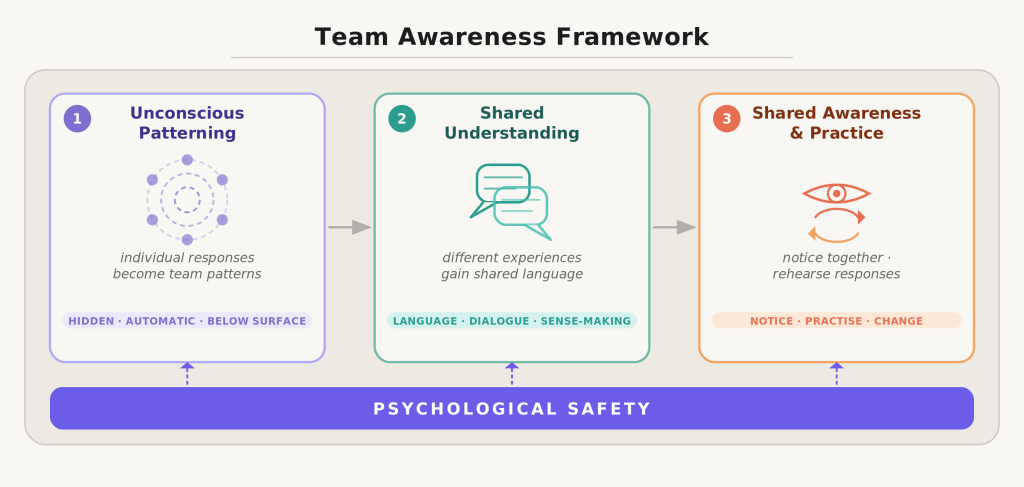
If you do have questions about how to build your own, and team awareness, please reach out for a conversation. The most effective teams are those that have looked beneath the surface of the assumptions that we each make.
Richard Galbraith Monday 20th May, 2026
References
Boyatzis, R. E. and Jack, A. I. (2018) ‘The neuroscience of coaching’, Consulting Psychology Journal: Practice and Research, 70(1), pp. 11–27. https://doi.org/10.1037/cpb0000095
Neta, M. (2026) ‘Facing ambiguity: what we do in the space between stimulus and response’, Current Directions in Psychological Science, 0(0). https://doi.org/10.1177/09637214261429347
Riddell, P. (2020) ‘Neuroscience coaching’, in Passmore, J. (ed.) The Coaches’ Handbook. Routledge, pp. 243–256. https://doi.org/10.4324/9781003089889-27